
SIM Card Sizes| From Full-Sized SIM to eSIM Technology
SIM card sizes evolved with time from the large physical card to the Nano and now eSIM technology. Mobile phones need a SIM card to make smooth communication possible. The alter in SIM shape led to the SIM slot design change.
This article is a guide about SIM card sizes. If you are thinking of switching providers, which SIM is perfect for you? Moreover, which one of the Subscriber Identity Modules is perfect for accessing a stable connection?
What Is a SIM Card and Why Its Size Evolved?
A SIM card, or Subscriber Identity Module, is the physical card that lets your phone connect with mobile networks. It stores the subscriber information like mobile number, identity details, and carrier information.
Initially, the SIMs were bulky. With the passage of time, manufacturers started developing smaller SIM cards to fit perfectly in mobile devices.
Despite the size, all the SIM cards have the standard thickness of 0.76mm. Nowadays, with the advancement in technology, the standard physical SIM card has evolved to the eSIM technology. eSIM is now considered a better and fast means of connection than SIM cards
Different Types of SIM Cards
Here is how a large physical SIM has evolved into a tiny digital chip.
1. Full-Size SIM Card (1FF)
1FF was the original credit card-sized SIM introduced in 1991. Initially, it was used in mobile phones. The dimensions of full full-sized SIM card were 85.6 mm × 53.98 mm × 0.76 mm. It enabled the mobile service but was too big to fit into the devices.
2. Standard SIM Card (2FF)
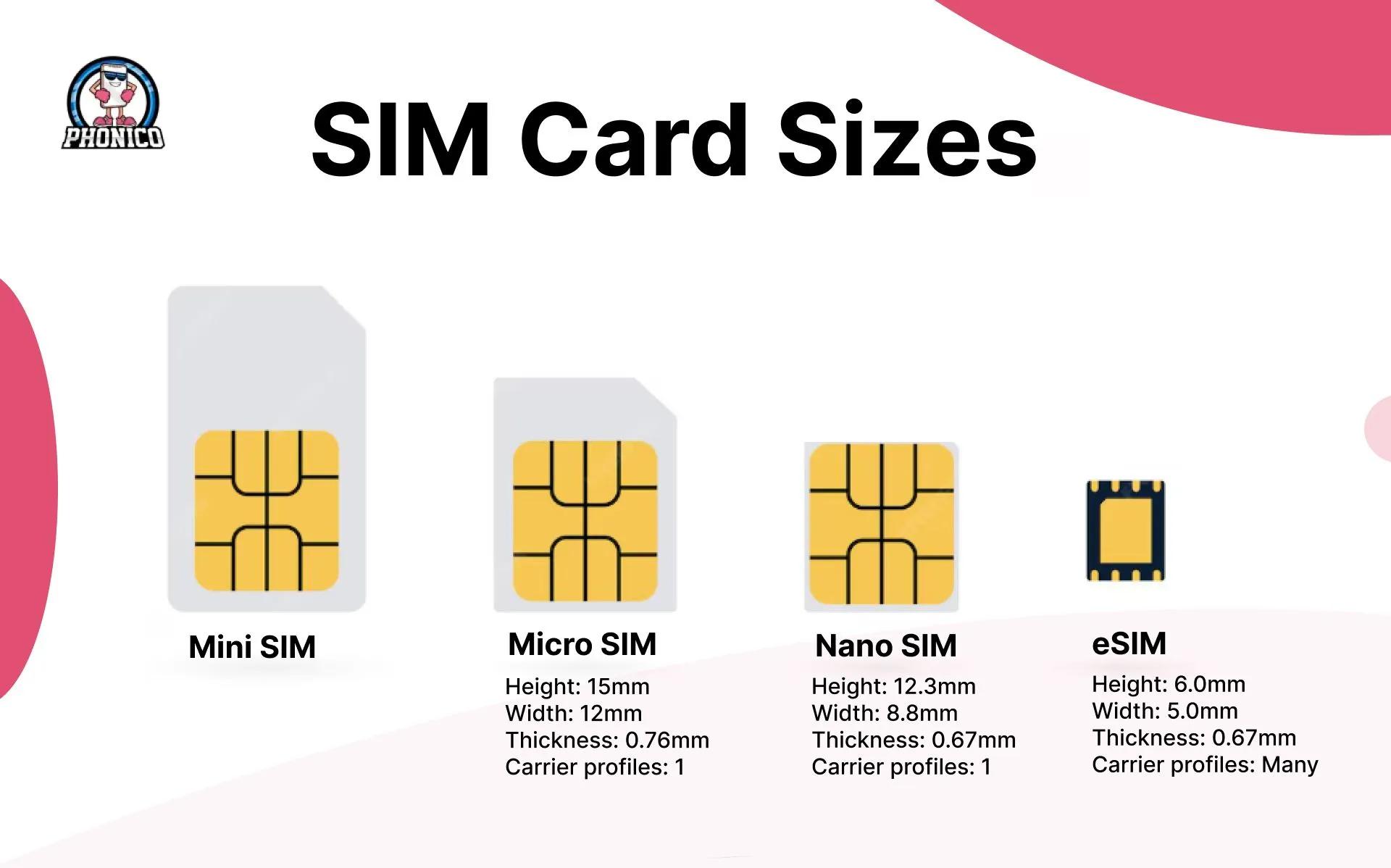
The standard SIM card succeeded the first full-sized SIM. It is called the standard or the mini SIM, which is used in phones with physical buttons. It was smaller than the 1FF, with dimensions of 25 mm × 15 mm × 0.76 mm.
The classic mobile phones had the SIM slots for the standard SIM.
3. Micro SIM Card (3FF)
Micro SIM is the smaller version of the standard SIM card with dimensions of 15 mm × 12 mm × 0.76 mm. It was the SIM card chip with a small surface area. It offers extra space for the device to improve the battery condition.
Micro SIM was used in the flagship Samsung Galaxy S5 and iPhone 4s.
4. Nano SIM Card (4FF)
Phone developers made the SIM cards smaller to nano SIM with a dimension of 12.3 mm × 8.8 mm × 0.67 mm. It is the thinner version of the physical chip now used in our phones. The SIM was introduced in 2012 and replaced the micro SIM.
iPhone 5 came into the market with the nano SIM slot in the same year. The card offered extra space in the phones to add more functionalities. 4FF is still used in smartphones and offers a better connection
5. eSIM Card Technology
An eSIM card is the latest version of the full-sized SIM card. It is the tiny digital chip that is already integrated into the devices. It can’t be removed or detached from the phone. Now, most of the mobile phones in the market are sold with this functionality.
Users are switching from physical SIMs to an eSIM card due to its affordability, security and reliability. Nowadays, it is considered the most convenient and stable way of connection.
How to Identify Your SIM Card Type?
The latest smartphones support the nano-SIM and embedded SM. The standard and micro SIM are used in classic keypad phones. If you are not clear about your phone's SIM card type, you can consider the following tips.
- Remove your device's SIM slot..
- Compared the SIM card slot with the size of the SIM.
In case of an eSIM card, you can contact your carrier or check your device's eSIM support from settings.
For iPhone Devices
- Open the iPhone Settings app.
- Click on the Cellular or Mobile Service.
- Find the Add eSIM or Add Cellular Plan. If the option is available, your iPhone supports eSIM.
For Android Devices
- Open the Settings app on your Android phone.
- Tap the Connection and the Network & Internet.
- Click on the SIM Manager and look for the Add eSIM.
eSIM Card: The Premium Connectivity Solution
An eSIM card is the premium connectivity solution compared to physical SIM cards. It digitally stores the user's information and avoids the risks of hacking and SIM swapping attacks. It eliminates the need for a physical SIM switch, which is ideal for international travellers.
Digital SIM offers multiple network access and allows you to switch between these in a few clicks to enhance the connection. To activate eSIM in your phone, you need the buy the eSIM data plan.
Multiple carriers offer plans, but ensure to choose the reliable one that offers effective services.
Phonico eSIM: A Reliable USA eSIM Provider
Phonico is the eSIM provider that offers a data plan for travel to the United States. The carrier offers a variety of data plans with unlimited talk and text services after purchasing the plan. You can activate eSIM in your iPhone or Android via QR code scan.
Compared to physical SIM cards, eSIM is an affordable and secure way to get connected. The latest dual SIM devices support the eSIM and physical SIM card simultaneously. You can keep your primary SIM active to make calls and texts, and eSIM for data.
Conclusion
SIM card size has evolved from the full-sized SIM to the latest digital eSIM technology. Each SIM card was developed to improve connectivity and fit into the latest devices. An eSIM card is now the premium, smarter, and the flexible way to access the internet.
FAQs
Why are SIM cards getting smaller?
SIM cards are getting smaller to offer extra space for other mobile functionalities. With small SIMs, now phones have bigger batteries and powerful processors.
What’s the main difference between a physical SIM and an eSIM?
A physical SIM card requires manual insertion. In contrast, an eSIM card is built into the devices and offers remote QR code activation.
Can I use a smaller SIM in a larger slot?
Yes, you can use the SIM adapter to adjust the smaller SIM into the larger slot. Avoid forcing the SIM; it might lead to damage.