
When did Texting Start? Test Messages History Guide
The first message was sent in 1992. From that time to now, text messages or SMS are an integral part of our communication. It is the predominant way for the billions of people to stay connected with their friends and family.
How and when did texting start? It is an interesting query to research. Who was the one started messaging and what was the first message delivered? In this article, I will discuss the history of text messaging.
Moreover, how simple SMS has evolved to the latest Rich Communication Services (RCS).
What Is Texting? The Short Message Service (SMS)
Texting is the written form of communication. It lets users send and receive written text through mobile devices. Texting uses the empty spaces in the mobile network that were meant for calling.
Short Messaging Service is a messaging app developed to send 160-character messages without extra bandwidth. Initially, in the 1980s, engineers set the message range. But now with the time, the limit is extended.
The Origins: Concepts and Standards Before the First Text
The concept of texting dates back to 1984. At that mobile phone was only specified to make calls. But Friedhelm Hillebrand and Bernard Ghillebaert founded the idea of texting when they were working with the Global System for the Communications.
The basis of texting was the short message service. Hillebrand’s research found that telex messages and memos had limited characters, which later shaped texting.
The First-Ever Text Message
A 22-year-old engineer, Neil Papworth, sent the first text message on December 3, 1992. While working for the telecommunications company, he sent the message from his computer to Richard Jarvis' mobile phone. Do you know what the message was?
The text was “Merry Christmas”. In the 1990s, mobile phones didn’t have keypads, so the message could only be sent via a computer. After that, people used text messages as the main form of communication.
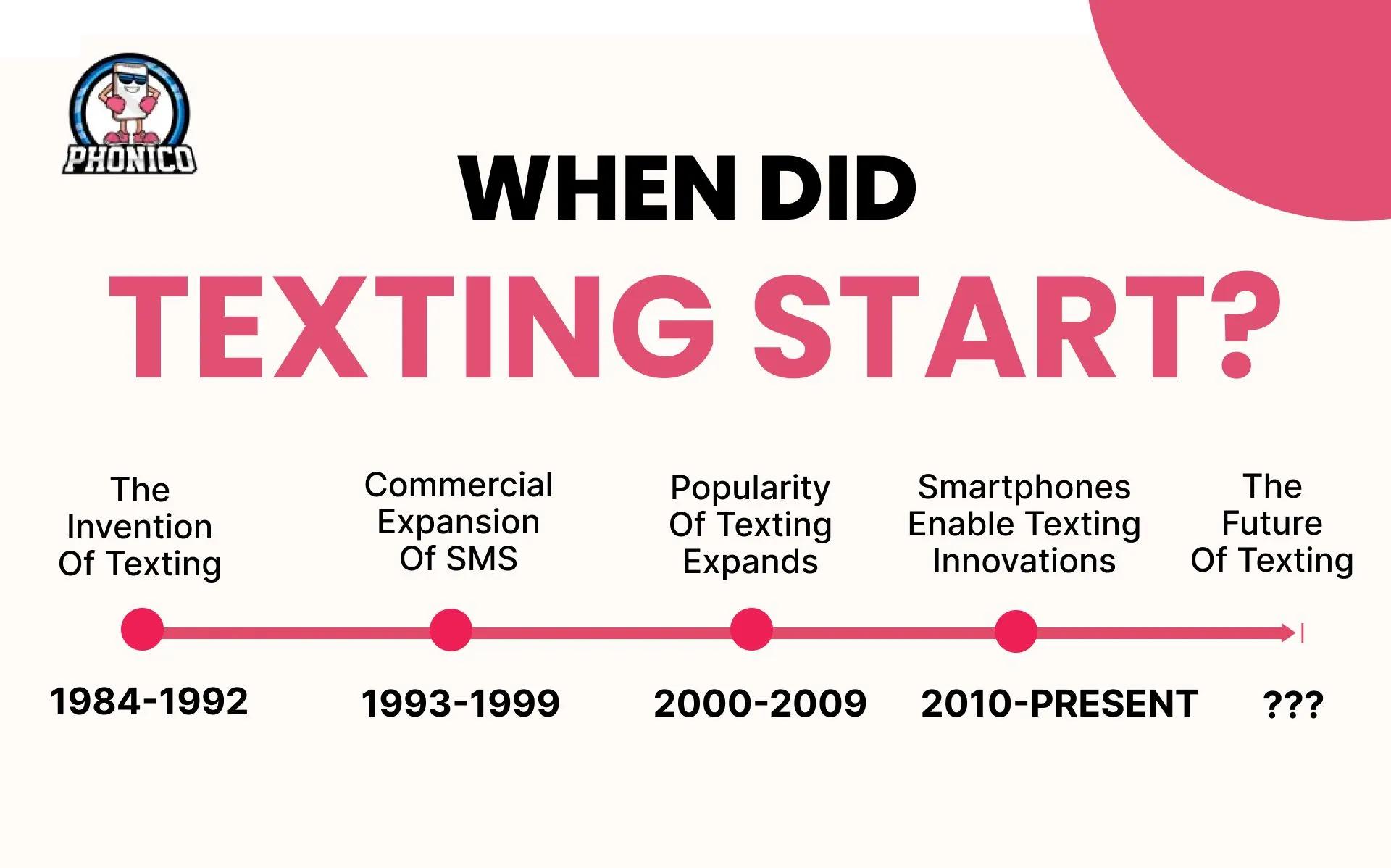
A Timeline of How SMS Evolved into Modern Messaging
Here is the timeline of SMS text messaging from Merry Christmas to the modern era of messages.
1992: The First-Ever Text Message
The first text was sent in 1992, with limited characters. It initiated the concept of Short Message Service, which allowed people to send and receive messages on mobile devices.
1994: Person-to-Person Texting Begins
A company called Radiolinja introduced the concept of person-to-person messaging in 1994. It allowed people to send messages directly. It was the initiative to begin SMS commercial for everyday use.
1995: SMS Becomes a Paid Service
In 1995, GSM offered prepaid text services and started commercialized texting. During this time, the T9 system ( text on 9 keys) was introduced, which made typing convenient on mobile phones. Similarly, people see predictive texting as helping users in suggesting words.
1996: The First Messaging App
ICQ was the first messaging app developed in 1996. Initially, it was not popular, but the app was the first step for the foundation of future mobile messaging apps. During that time, no emoji, color, or group chat option was available in the app.
Initially, it was restricted to sending messages only within the same network. In 1999, users were allowed to send and receive messages between different networks.
Early 2000s: The Texting Boom
Texting became most popular in the early 2000s. The average user was sending 35 texts per month. Texts like LOL and OMG appear as slang among college students. In 2002, MMS (Multimedia Messaging Service) came to the market.
Now the users are allowed to send photos and videos to their friends and family.
2001–2006: From Trend to Daily Habit
Texting became a popular tool for communication. Compared to calling, it was a cheaper and private version of communication. In 2007, the text messages reported in the USA exceeded the number of phone calls.
2009: Messaging Apps Revolution
Unlike SMS, in 2009, a new messaging app called WhatsApp was launched. The app used the internet connection to let people send messages, photos, and videos throughout the world.
2010s: The Smartphone Era
The rise of smartphones and texting apps like iMessage, WhatsApp, and Facebook Messenger, revolutionized texting. Users are allowed to send and receive high-quality media files.
Present Day Rich Communication Services (RCS)
Nowadays, traditional messaging services have evolved to the latest Rich Communication Service (RCS). It lets users read receipts, typing indicators, file sharing, and send video messages.
The Role of eSIM in the Modern Era of Texting and Mobile Communication
eSIM technology is the latest version of connectivity. It ensures a smooth data connection, calling, and texting compared to traditional SIM cards. It is the built-in technology that instantly activates the SMS.
But to enjoy stable networking, ensure that your device supports the eSIM technology. Compared to international data roaming, local SIM cards or portable WiFi routers, an embedded SIM is an affordable way to let you connect during travel.
Note: If you are looking for the best eSIM, Phonico offers the USA eSIM data plan with unlimited talk and texts. You can enjoy the data without any additional costs or data roaming charges.
Conclusion
Texting started in 1992. The first message was sent from the computer to the phone with the text “Merry Christmas.” Since then, plain texting has evolved into RCS as a powerful tool of communication.
Now, billions of people send messages every day, which is refined with technology. Multiple apps are available for texting, which allow users to stay connected worldwide.
FAQs
What’s the difference between SMS, MMS, and RCS messages?
SMS is a plain messaging service with a 160-character limit. MMS lets users share multimedia files. RCS is the modern texting service that allows read receipts, typing indicators, and file sharing.
When did texting become popular in the US?
In early 2000, texting became popular in the USA due to the cross-network availability.
What was the old texting called?
Initially, texting was called paging, and the device used for texting was known as a pager.